The Future of IT Onboarding: Fully Automated Day-1 Workflows

Vlad Shlosberg
Founder
Few moments reveal the maturity of internal operations more clearly than a new employee's first day.
Onboarding is often discussed as a people experience, and rightly so. But it is also one of the most operationally revealing workflows in the enterprise. If identity, access, devices, approvals, and communication are not coordinated well, the new hire feels it immediately. The same is true of their manager. Day 1 is not simply an HR milestone. It is a live test of how well the company's systems and teams work together.
That is why onboarding has become one of the most important automation opportunities in IT.

Onboarding Is Not a Ticket—It's an Orchestration Layer
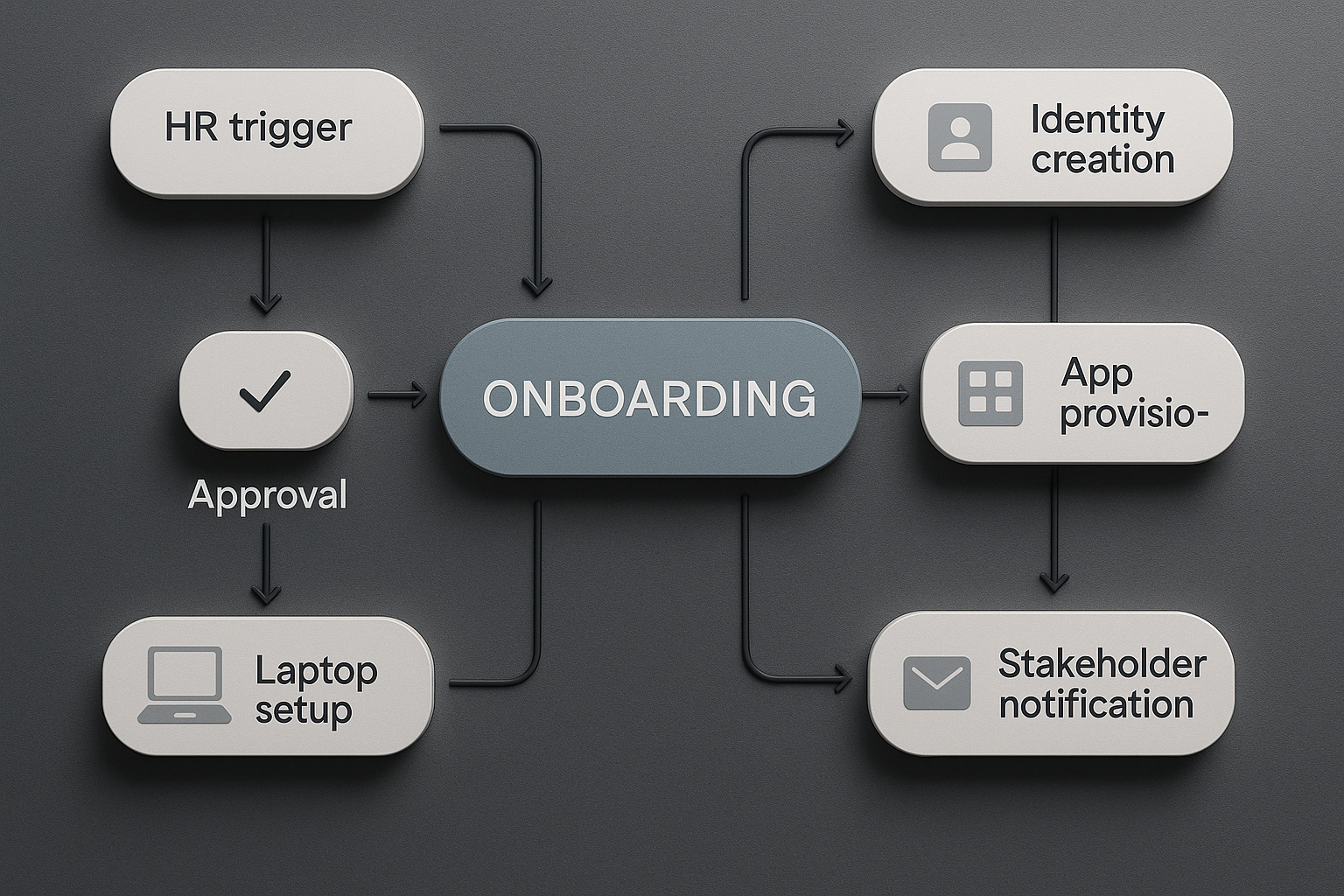
At first glance, onboarding can appear to be just another ticket-based process. A request is submitted, work is assigned, accounts are provisioned, and equipment is prepared. But in practice, onboarding is not a single task. It is an orchestration layer spanning:
- HR systems
- IT infrastructure
- Security policies
- Finance approvals
- Procurement
- Identity management
- Collaboration tools
- Device management
The number of steps involved varies by company, but the core challenge is the same: there are too many dependencies for manual coordination to remain reliable at scale.
This becomes especially visible in organizations growing quickly or operating across multiple teams, regions, or toolsets. One missed approval, one delayed hardware task, one incorrectly assigned group, or one missing application entitlement can turn a carefully planned start date into a fragmented experience. Employees often interpret those failures as simple disorganization. Operationally, they are usually symptoms of workflows that rely too heavily on human memory, informal communication, or disconnected systems.
What Full Automation Actually Means
That is why fully automated Day-1 workflows are becoming increasingly important.
To be clear, full automation does not mean removing people from onboarding altogether. It means reducing the number of steps that still depend on manual handoff when those steps follow clear rules and repeatable patterns. Most new hires do not require a blank-sheet design process. They fall into recognizable categories defined by:
- Department
- Role
- Location
- Employment type
- Access profile
Once those patterns are clear, many of the surrounding actions can be triggered predictably.
What a Strong Onboarding Workflow Can Do Automatically:
- Ingest hire data from a source system
- Identify the correct manager
- Route required approvals
- Create the identity
- Assign baseline groups
- Provision standard applications
- Trigger hardware tasks
- Apply security policies
- Notify relevant stakeholders at the right moment
The value is not just speed, although speed matters. The deeper value is consistency.
Why Automation Has Both Practical and Symbolic Importance
In our customer conversations, onboarding remains one of the clearest examples of where automation has both practical and symbolic importance:
Practically: It reduces repetitive work, minimizes missed steps, and improves security hygiene.
Symbolically: It signals that IT is moving beyond reactive support into operational design. It reflects a service organization that is building systems, not just handling requests.

Four Conditions That Enable Onboarding Automation
Several conditions make this possible:
1. A Trustworthy Source of Truth
Automation cannot compensate for poor input quality. If HR or people systems contain incomplete or inconsistent hire data, everything downstream becomes less dependable. That is why onboarding maturity often begins with alignment around what data is authoritative and when it becomes available.
2. Role-Based Logic
Many organizations delay automation because they assume every access scenario is unique. In reality, while exceptions do exist, most organizations have a relatively stable set of access patterns by function. Engineering, sales, finance, support, HR, contractors, and executives often require different access bundles, but those bundles can still be standardized enough to automate large portions of the process.
3. Contextual Approval Design
Automation should not bypass governance. It should make governance faster and more coherent. Approvals are most effective when they occur close to the right stakeholder, with enough context to make a timely decision and without forcing the request into an awkward handoff between systems.
4. End-to-End Visibility
Onboarding often breaks down because each team sees only its part of the process:
- IT sees provisioning
- HR sees the start date
- Procurement sees equipment orders
- Managers see only the absence of readiness
A modern onboarding workflow should make status legible across the chain, so that stakeholders are not relying on side-channel updates to understand where things stand.
The Conceptual Shift
The most important shift, however, is conceptual. Organizations that modernize onboarding stop treating it like a queue problem and start treating it like a systems coordination problem.
That changes both the design approach and the success criteria. The question becomes less about how quickly a ticket is closed and more about whether the employee is actually ready to work, securely and effectively, on the day they begin.
That is a higher standard, but it is the right one.
Onboarding as a Benchmark for Operational Excellence
Looking ahead, Day-1 workflows will increasingly become a benchmark for operational excellence. The organizations that perform well here will not simply be the ones with more automation in the abstract. They will be the ones that combine:
- Trustworthy source data
- Role-aware provisioning
- Intelligent approvals
- Clear status visibility
...into a workflow that feels seamless to the employee and manageable to the teams behind it.
When that happens, onboarding stops being an administrative scramble and becomes what it should be: a confident, coordinated beginning.
And that matters far more than most companies realize.
Ready to automate your Day-1 workflows? See how Foqal connects HR systems, identity providers, and service tools to create fully automated onboarding experiences in Slack and Teams.
Subscribe to our newsletter
Get the latest insights on IT operations, AI, and workplace productivity delivered to your inbox.
Ready to transform your support?
See how Foqal can help your team deliver faster, smarter support.
Start Free TrialRelated Articles
Why Every IT Team Is Becoming an Automation Team
Discover how modern IT teams are shifting from routine support tasks to strategic automation, turning repetitive workflows into streamlined, scalable processes that boost efficiency and reduce toil.
Why IT Automation Projects Fail (And How to Fix Them)
Discover why most IT automation projects stall and learn a disciplined, step‑by‑step approach to map, own, and measure workflows so you can turn painful processes into reliable, high‑impact automations.
The Death of the Ticket: Why Slack and Teams Are Becoming the IT Interface
A growing shift to Slack and Teams is turning chat into the front‑line for IT support, while tickets become invisible infrastructure that still powers workflow, compliance, and reporting.