The Death of the Ticket: Why Slack and Teams Are Becoming the IT Interface

Vlad Shlosberg
Founder
The ticket is not disappearing. But its role is changing in a fundamental way.
For decades, the ticket has been the central object of service delivery. It represented work, ownership, priority, status, and accountability. It was the primary interface through which requests entered the service operation and through which agents managed them. In traditional ITSM environments, that made sense. The portal and the ticket were tightly connected. If you needed help, you went to the system designed to receive it.
That model is now under pressure—not because tickets are no longer useful, but because the environments where employees actually work have changed.
Work Has Moved to Collaboration Tools
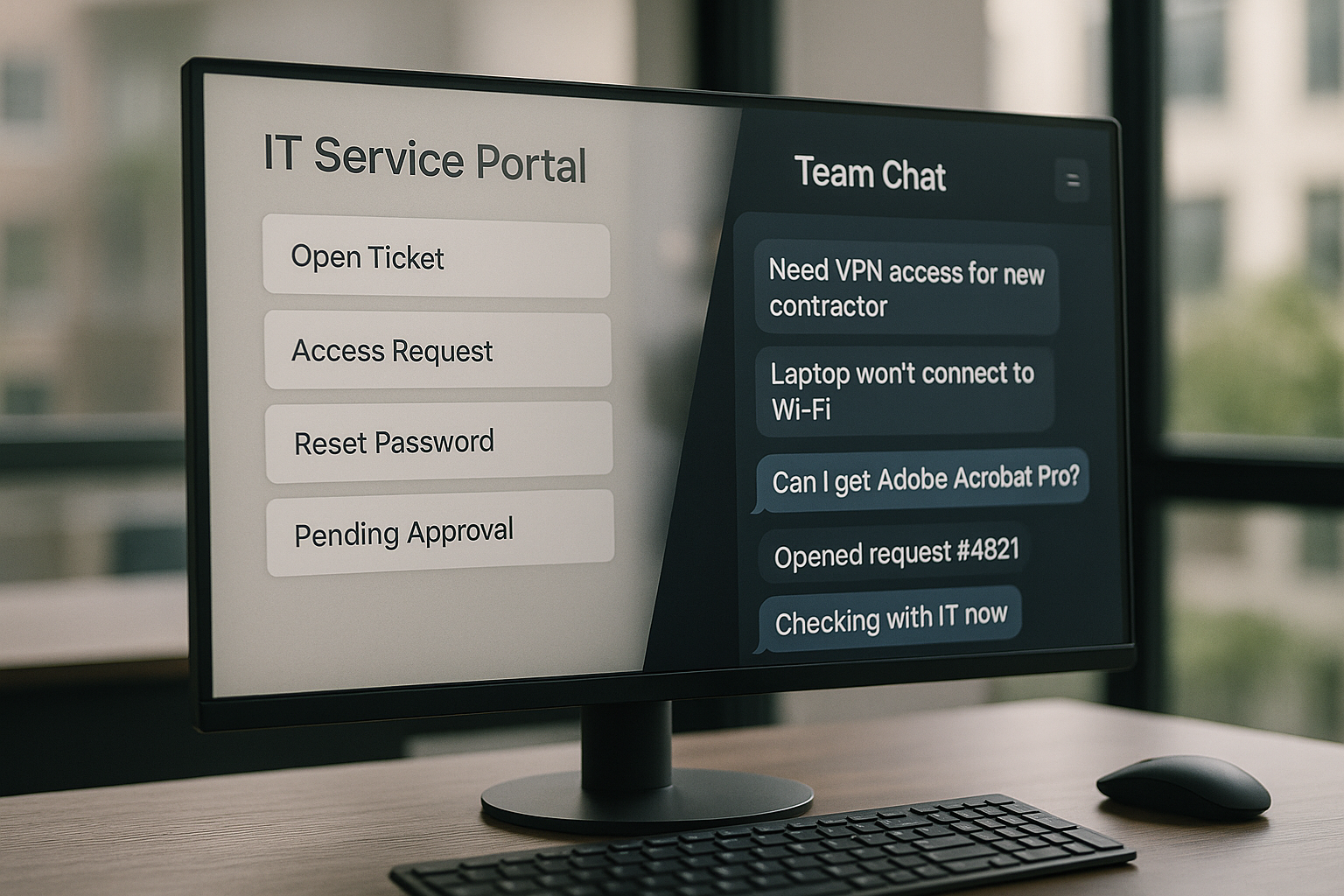
Today, most work begins in collaboration tools. Slack and Teams are not peripheral channels. They are where questions are asked, decisions are made, documents are shared, approvals are discussed, and problems surface in real time. That makes them, increasingly, the natural place where service interactions begin as well.
The significance of this shift is easy to underestimate. It is not merely about adding another intake channel. It reflects a deeper change in how employees experience internal support. People no longer think first in terms of systems. They think in terms of context. If they are already in a conversation, they expect to be able to ask for help there. If they are already collaborating in a channel, they expect the service experience to be accessible within that environment.
That is why chat-based service is gaining momentum across IT and other internal functions.
The Persistent Pattern
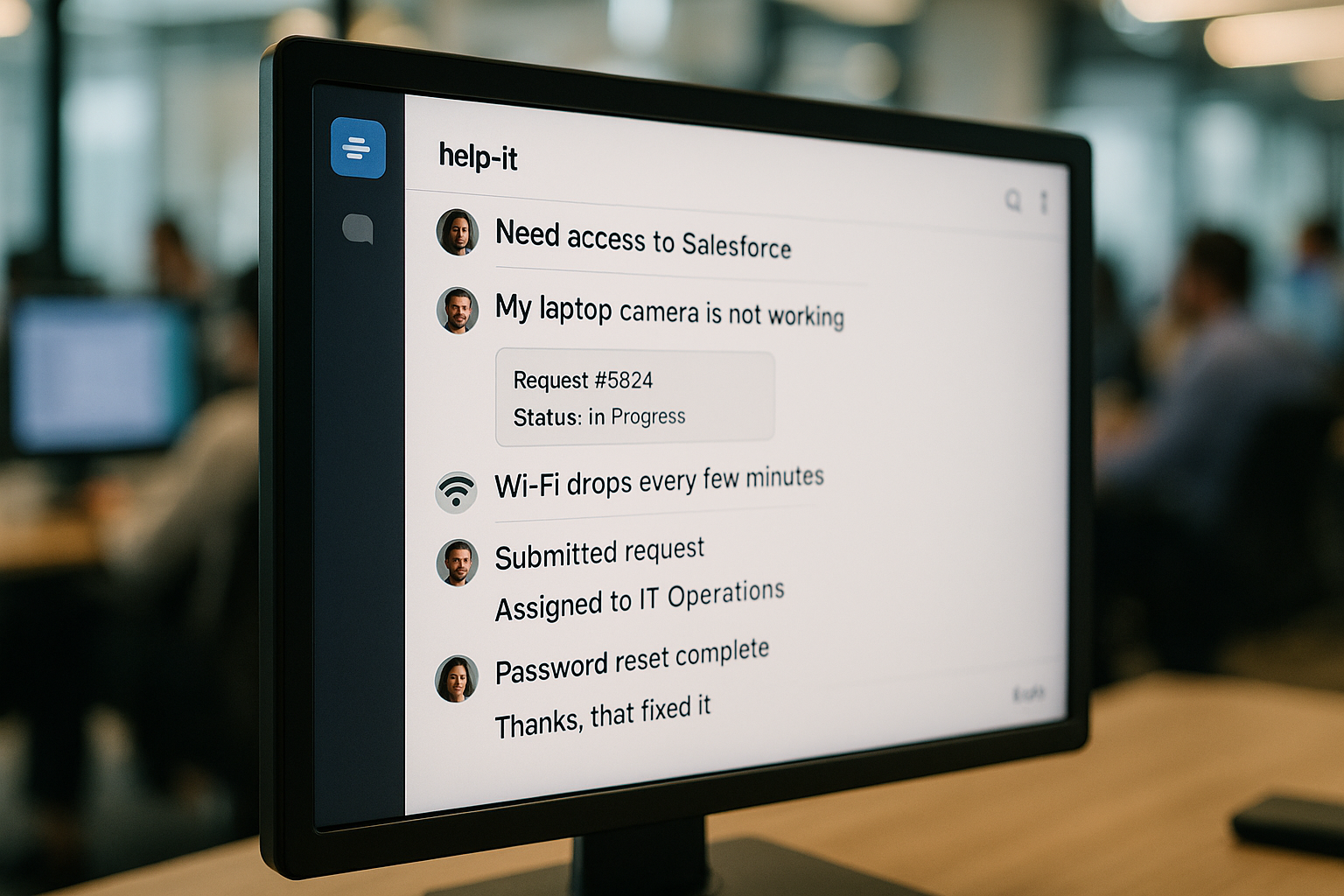
In customer conversations, one of the most persistent patterns is that employees naturally default to messaging-based behavior even when a formal portal exists:
- They ask in a help channel
- They send a DM to someone they know
- They respond in a thread
- They raise operational issues in the same place they discuss everything else
This is not just convenience. It reflects the fact that chat has become the default interface for work itself.
The Opportunity and the Challenge
For IT leaders, this creates both an opportunity and a challenge.
The Opportunity
The opportunity is obvious. Slack and Teams offer a much more accessible and context-rich front end for service interactions:
- Requests can begin conversationally
- Follow-up questions can happen in thread
- Screenshots, approvals, clarifications, and updates can all stay close to the original interaction
- In many environments, this reduces abandonment and improves responsiveness simply because the service interaction is happening where people already are
The Challenge
The challenge is that chat by itself does not replace operational structure. If requests remain informal, service teams lose visibility, routing discipline, reporting, and auditability. The absence of a ticket does not mean the absence of work. It means the work becomes harder to govern.
The Ticket as Infrastructure, Not Interface
This is why the future is not really about the end of the ticket. It is about the repositioning of the ticket.
Increasingly, the ticket is becoming infrastructure rather than interface. It still matters for everything it has always mattered for:
- Ownership
- Triage
- Records
- Workflow execution
- Automation
- Compliance
- Reporting
But it no longer has to be the first thing the user encounters. Instead, it can be created, synchronized, or enriched behind the scenes while the user interacts through chat.
That is a major design shift.

How Modern Service Works
In a more modern service model:
- The employee begins in Slack or Teams
- The system captures intent, collects context where needed
- It distinguishes between low-friction questions and structured requests
- It creates the underlying ticket or task record automatically
- Agents may continue to work in a web interface, in the service platform itself, or partially within chat, depending on what makes the most sense operationally
The key point is that the ticket still exists, but the user no longer has to start there.
This matters because it aligns service delivery with actual work behavior. It reduces the distance between the user's moment of need and the team's operational process. It also creates room for more modern patterns:
- Contextual approvals
- Private versus public request handling
- AI-assisted answer suggestions
- Dynamic request forms
- Workflow-driven follow-up
- Bi-directional updates between service systems and collaboration tools
Chat as the Service Surface
Seen this way, Slack and Teams are not replacing service management. They are becoming the surface through which service management is experienced.
That distinction is essential for IT leaders thinking about the future of internal support. The question is not whether chat can replace rigor. The question is whether rigor can be embedded into conversational interfaces in a way that feels natural to employees and still reliable to the service organization.
The evidence increasingly suggests that it can.
What This Means for IT Teams
What this means in practice is that service teams should stop treating collaboration platforms as edge channels and start treating them as primary operating environments. The service architecture then needs to support that reality. Intake, triage, automation, and reporting must all adapt accordingly.
The Ticket Evolves
The ticket is not dead. But it is becoming less visible, less central to the user experience, and more integrated into a broader service fabric that begins in communication rather than in a portal.
In many ways, that is exactly what mature infrastructure should become: essential, dependable, and largely invisible to the people it serves.
That is where internal service is headed, and the teams that recognize it early will be in a much stronger position to design for the next generation of employee expectations.
Transform your IT service experience with Foqal—bring structured ticketing into Slack and Teams while maintaining full operational control behind the scenes.
Subscribe to our newsletter
Get the latest insights on IT operations, AI, and workplace productivity delivered to your inbox.
Ready to transform your support?
See how Foqal can help your team deliver faster, smarter support.
Start Free TrialRelated Articles
Why IT Teams Hate Logging Into Ticketing Systems
Discover why ticketing systems often fail and how integrating requests directly into Slack or Teams can eliminate friction while preserving IT governance.
Why IT Teams Are Replacing Jira and ServiceNow
Discover why IT teams are shifting from traditional Jira and ServiceNow interfaces to friction‑less, chat‑based experiences that keep the powerful back‑end while dramatically improving user satisfaction.
The Problem with AI IT Support Bots
Discover why AI support bots often fall short and how a hybrid approach—combining AI‑driven knowledge retrieval with human‑guided workflows—can turn AI into a powerful accelerator for IT service delivery.